
There is a ticket in Rome that covers three sites and almost everyone uses two of them. It gets you into the Colosseum, the Roman Forum and the Palatine Hill, and by the time most visitors have done the first two, the heat has won and the hill above them stays unclimbed.
Which is how the best view in central Rome ended up being the quiet one.
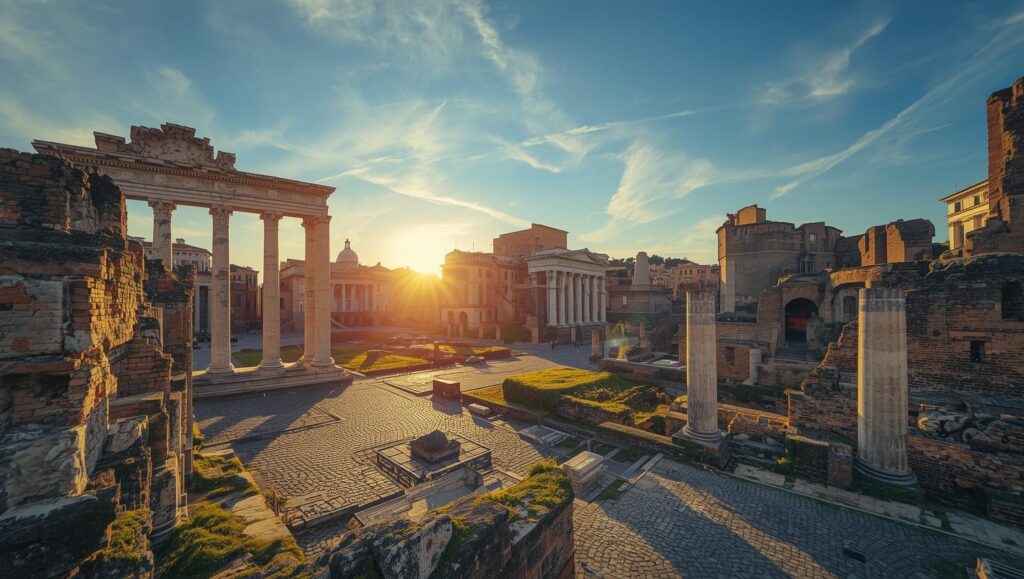
What the Palatine actually is
It is the hill where Rome began, and later the hill where Rome was governed. Augustus lived here. So did every emperor after him for three centuries, each one building over the last, until the whole summit was a single imperial residence sprawling above the Forum.
The word palace comes from this hill. Not the other way round.
What survives is not a set of tidy monuments. It is brick, vaulted substructure, the shell of a stadium-shaped garden, and a long terrace looking straight down into the Circus Maximus. You do not walk the Palatine to identify rooms. You walk it to understand the geometry of power in the ancient city: the emperor above, the races below, the Forum on the other side, all of it visible from one spot.
Why it is empty when the Colosseum is not
Three reasons, and none of them are about the site being less interesting.
The first is the ticket. Because entry is bundled, the Palatine feels like an extra rather than a destination, and extras get dropped when legs get tired.
The second is the order people walk it. Almost everyone enters at the Colosseum, crosses into the Forum, and comes out exhausted at the far end having spent their best hours on the flat. The hill is the climb at the end, in the afternoon, in August.
The third is that nothing on the Palatine announces itself. There is no single object to photograph. It rewards someone explaining it, and punishes the visitor doing it from a phone screen.
The fix is simply to reverse the route
Start on the Palatine. Enter from the Via di San Gregorio gate rather than the Colosseum one, climb while you are still fresh, and look down on the Forum before you walk through it. Everything you see afterwards at ground level makes more sense, because you have already seen the plan of it from above.
Then come down into the Forum, and finish at the Colosseum when the light is long and the morning groups have gone. That is the order our Colosseum, Forum and Palatine day uses, and it is the single change that makes the most difference to how the three hours feel.
What to look for once you are up there
The terrace over the Circus Maximus
Stand at the southern edge and the whole valley of the Circus opens below — 600 metres of it, still the shape it was, now grass. The imperial box was here. The emperor watched the races from the house he lived in, which tells you more about Roman politics than any plaque.
The Farnese Gardens
On the northern crest, laid out in the sixteenth century over the ruins of Tiberius’s palace, and generally considered the first private botanical garden in Europe. Box hedge, umbrella pines, a pair of pavilions, and a terrace that looks across the entire Forum. It is also the most reliable shade on the hill.
The brickwork itself
Once someone points out how Roman concrete walls were faced — the diamond pattern, the brick triangles, the way an arch is built over a void — you cannot stop reading it, and the ruins change from rubble into construction.
Practical things worth knowing
The combined ticket is valid across the sites, and the Palatine and Forum share an enclosure: once you are inside you move between them freely. Entry to the Colosseum itself is timed, so that slot anchors the day.
Allow two hours for the hill and the Forum together if you are moving steadily, three if you intend to sit down, and add the Colosseum on top of that.
Wear something with a sole. The surfaces are ancient paving, gravel and uneven brick, and the hill is a hill.
There is very little shade between eleven and four on the open stretches, which in June, July and August is not a comfort issue but a planning one. Early morning or the last two hours before closing are the civilised windows.
If you have more than one day in Rome
The Palatine pairs naturally with the city at ground level rather than with another ruin. A morning on the hill and an afternoon walking the centro storico gives you two Romes that explain each other.
And if you only ever see Rome in daylight you are missing the version locals prefer. The Forum lit from outside the fence, Piazza Navona at ten at night, the Pantheon with nobody in front of it — that is what our Rome by night is for.
The Vatican is a separate appetite and a separate day. Do not stack it against the Forum unless you genuinely enjoy museums at scale; the Vatican and the Sistine Chapel deserve a morning of their own.
The short version
The Palatine is included in a ticket you are already buying, it holds the best view of the Forum in the city, and most people skip it because they climb it last. Walk it first, go early, and let someone explain the brick.
We plan private days in Rome for travellers who would rather understand a place than photograph it. See how we work, or tell us what you have in mind.